
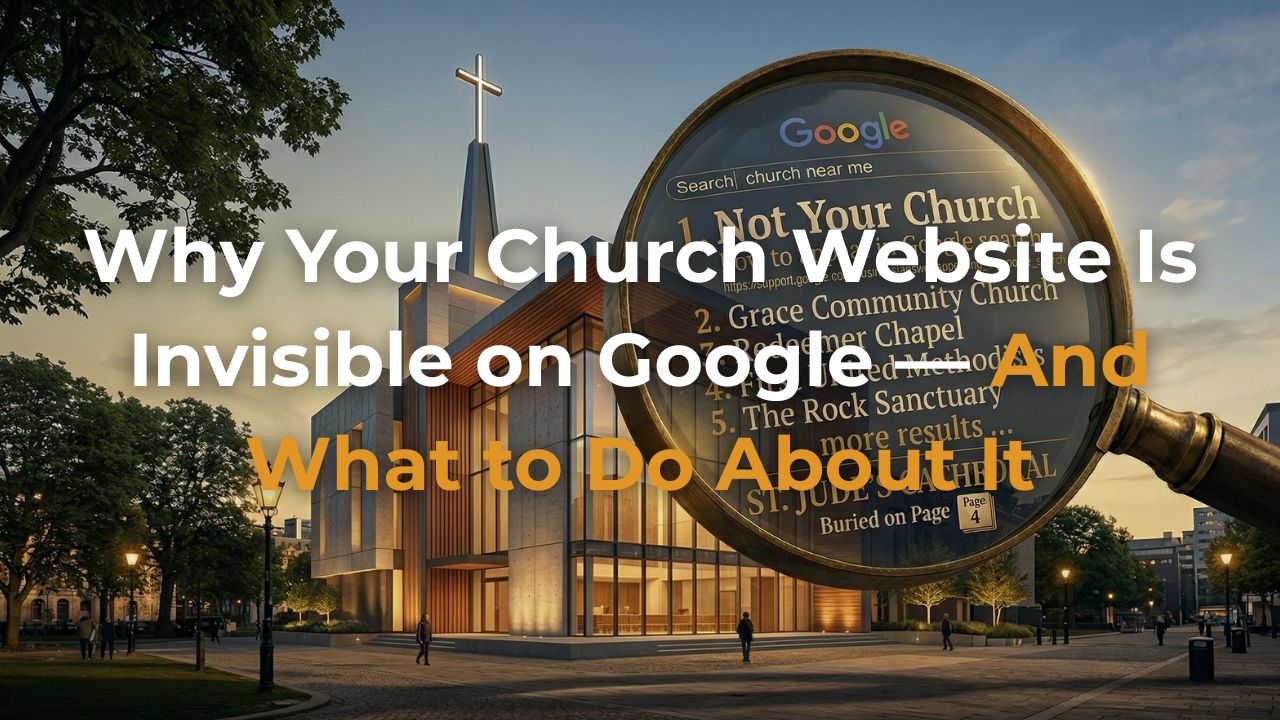
Why Your Church Website Is Invisible on Google — And What to Do About It
Mar 27, 2026If you searched for your church on Google right now, you'd probably find it. But that's not the search that matters most.
The search that matters is the one happening right now from someone in your suburb who has never heard of your church. Someone typing "church near me," "Christian community [your suburb]," or "kids programs [your area]" into Google on their phone.
Are they finding you? For most Australian churches the honest answer is no.
In this post we're going to look at exactly why that is — and what you can do about it.
Why this matters — the numbers
Sources: Google Search Central · Backlinko Search Engine Results Page Study
The Visibility Problem Most Churches Don't Know They Have
Most church leaders assume that because their church has a website, people can find them online. Unfortunately having a website and being visible on Google are two very different things.
Google doesn't automatically show every website to every person who might be interested in it. It ranks websites based on hundreds of factors — relevance, authority, speed, structure, content quality and more. A website that hasn't been optimised for these factors can sit on page four or five of Google's results — which for most practical purposes means it doesn't exist.
Think about the last time you clicked to page four of a Google search. Exactly.
The good news is that most of the reasons church websites are invisible on Google are fixable. And fixing them doesn't require a complete website rebuild — just targeted improvements in the right areas.
The visibility problem
7 Reasons Your Church Website Is Invisible on Google
The website hasn't been updated
Google favours regularly updated sites. A church website unchanged since last Easter signals to Google that nobody is home.
No local SEO setup
Without local SEO Google doesn't know where you are or who you serve. A few simple steps can make a significant difference to your local visibility.
The website is slow to load
Google penalises slow websites — particularly on mobile. If your site takes more than 3 seconds to load, Google will rank it lower than faster competitors.
The website isn't mobile friendly
More than 60% of Google searches happen on mobile. If your site doesn't display correctly on a phone Google will rank it lower than mobile-friendly sites.
No Google Business Profile
Without a Google Business Profile your church is significantly less visible in local search results — particularly on Google Maps. Setting one up is free.
Content doesn't match search terms
If someone searches "grief support church Blue Mountains" and your website never mentions those words — Google has no reason to show your site in those results.
No other websites linking to you
Backlinks from reputable websites are one of Google's most important ranking factors. Getting listed on local directories and denomination sites makes a real difference.
The 7 Most Common Reasons Church Websites Are Invisible on Google
1. The Website Hasn't Been Updated in Months
Google favours websites that are regularly updated with fresh, relevant content. A church website that hasn't changed since last Easter sends a signal to Google that nobody is home. Regular blog posts, updated event pages, and fresh sermon content all tell Google that your site is active and worth showing to people.
2. There's No Local SEO Setup
Local SEO is what helps your church show up when someone searches for a church in your specific area. Without it Google doesn't know where you are or who you serve. A few simple steps — including setting up a Google Business Profile, adding your suburb and postcode to your website content, and using location-specific keywords — can make a significant difference to your local visibility.
3. The Website Is Slow to Load
Google penalises slow websites — particularly on mobile. If your church website takes more than three seconds to load on a phone, Google will rank it lower than faster competitors. Common culprits include large uncompressed images, outdated plugins, and cheap hosting. A fast website isn't just good for SEO — it's also better for the visitor who would otherwise click away before your page even loads.
4. The Website Isn't Mobile Friendly
More than 60% of Google searches happen on mobile devices. If your church website doesn't display correctly on a phone — with text that's too small to read, buttons that are hard to tap, or layouts that break on smaller screens — Google will rank it lower than mobile-friendly sites. This is non-negotiable in 2026.
5. There's No Google Business Profile
A Google Business Profile is the listing that appears on the right side of Google search results when someone searches for a specific business or organisation. It shows your address, phone number, website, opening hours and reviews. Without one your church is significantly less visible in local search results — particularly on Google Maps. Setting one up is free and takes less than an hour.
6. The Page Content Doesn't Match What People Search For
Google matches search queries to page content. If someone searches "grief support church Blue Mountains" and your website never mentions grief support, Blue Mountains, or the specific suburb you serve — Google has no reason to show your site in those results. Your website content needs to use the specific words and phrases your community is actually typing into Google.
7. There Are No Other Websites Linking to You
One of Google's most important ranking factors is how many other reputable websites link to yours. In the SEO world these are called backlinks. Churches often have very few of these because they don't think about building them. Simple strategies — like getting listed on local community directories, having your denomination link to your church page, or being mentioned in a local news article — can significantly improve your authority in Google's eyes.
What About the Google Ad Grant?
It's worth noting that even if your church website has SEO challenges, the Google Ad Grant can still work for you — because paid search ads appear above organic results regardless of your website's SEO ranking.
In fact for many churches the Google Ad Grant is the fastest path to Google visibility while the longer term SEO work is being done in the background. You can be showing up at the top of Google search results within days of your grant being activated — even if your organic SEO ranking takes months to improve.
The two strategies work best together. The Ad Grant gets you immediate visibility. Good SEO builds your long term presence. Both are important.
A Simple Website Audit You Can Do Right Now
Before spending money on any SEO tools or services run through this quick checklist for your church website:
- Does your website load in under 3 seconds on a mobile phone?
- Does it display correctly on a smartphone screen?
- Does it have HTTPS (the padlock icon in the browser bar)?
- Does it mention your suburb and local area in the text?
- Does it have a clear mission statement on the About page?
- Does it have your ABN and ACNC charity status in the footer?
- Does it have a Privacy Policy page?
- Has it been updated with new content in the last 30 days?
- Does it have a Google Business Profile set up and linked?
- Does it have a clear way for visitors to take a next step — a contact form, an event registration, or a newcomer welcome page?
If you answered no to three or more of those questions your website has significant visibility issues that are costing your church potential visitors every single week.
How Long Does It Take to Fix?
The good news is that most of these issues can be addressed relatively quickly. Here's a rough timeline:
- Google Business Profile setup — 1-2 hours
- Image compression and speed improvements — 2-4 hours
- Local SEO content updates — 3-5 hours
- Mobile responsiveness fixes — depends on the platform but usually 2-4 hours
- Regular content updates — ongoing, but a consistent blog post once a week makes a significant difference within 3-6 months
The longer term work — building backlinks and establishing content authority — takes 6-12 months to show significant results. But the foundational fixes can improve your visibility noticeably within 30-60 days.
Where to Start
If you're feeling overwhelmed by this list start with these three things first — they have the highest impact for the least effort:
- Set up your Google Business Profile if you don't have one — it's free and takes less than an hour
- Make sure your website mentions your suburb and local area throughout the content — particularly on your homepage and About page
- Start publishing regular content — even one blog post per week based on your Sunday sermon makes a significant difference to how Google sees your site over time
Need Help Making Your Church Website Visible?
At DEO Ministry we help Australian churches fix their website visibility as part of every package we offer. From cleaning up your website and setting it up for the Google Ad Grant to managing your ongoing content and local SEO — we handle the technical side so your pastoral team can focus on ministry.
If you'd like to find out exactly what's holding your church website back from showing up on Google book a free 30-minute strategy call. We'll take a look at your site, identify the specific issues, and walk you through what it would take to fix them.
Book Your Free Strategy Call →
Written by Daniel Jackson - The founder of DEO Ministry and an elder at Soma Blue Mountains. He holds a MDiv from Christ College Sydney and a MATh from SMBC. He has helped scale businesses to over $1,000,000 in annual turnover and is passionate about helping Australian churches use digital tools to reach more people with the gospel.