
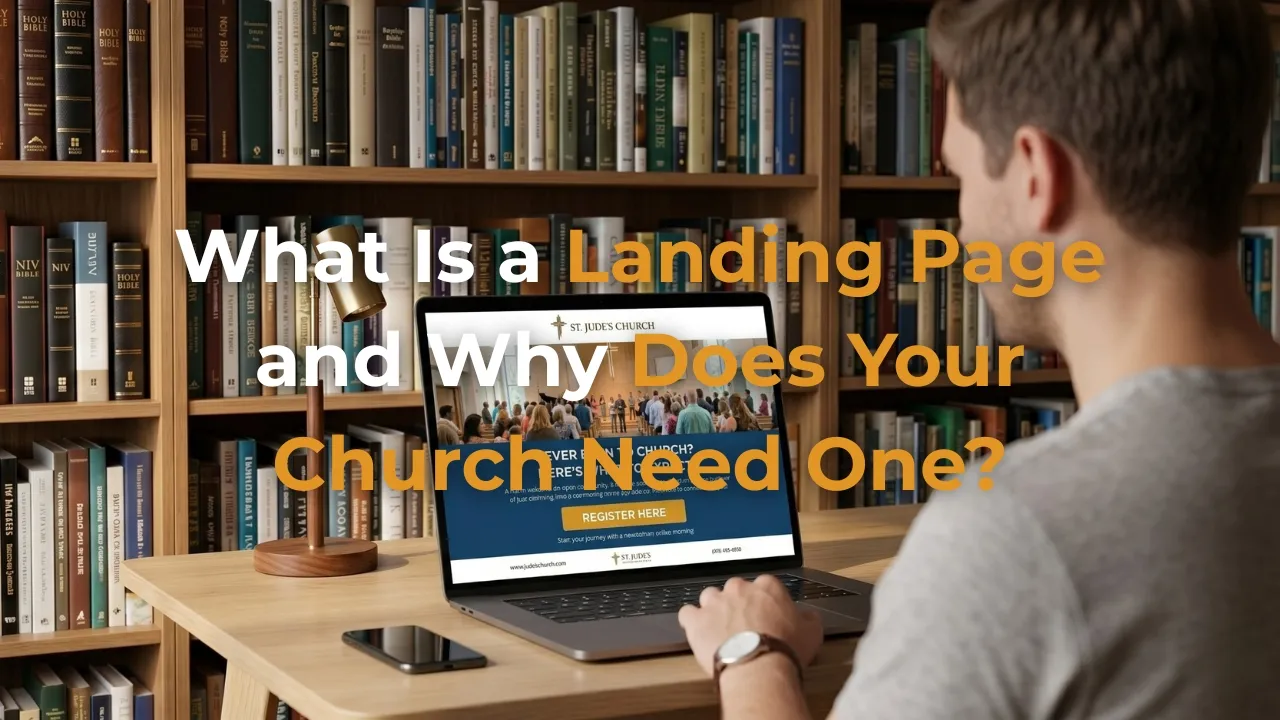
What Is a Landing Page and Why Does Your Church Need One?
Apr 28, 2026If your church is running Google ads — or planning to use the Google Ad Grant — there is one thing that will determine whether those ads actually bring people through your doors or simply drive traffic that bounces straight off your website.
That thing is a landing page.
In this post I'm going to explain exactly what a landing page is, why it matters so much for churches, and what a well-designed church landing page actually looks like in practice.
What Is a Landing Page?
A landing page is a single, focused web page designed for one specific purpose — to convert a visitor into a connection.
Unlike your homepage, which is designed to give an overview of everything your church does, a landing page is designed for one audience, with one message, and one clear call to action. Nothing else. No links pulling people away to other parts of your site. Just one focused conversation with one specific person about one specific thing.
The name comes from the idea that this is the page someone "lands on" after clicking a link — whether that's a Google ad, a social media post, an email, or a short form video clip.
Why Your Homepage Is Not a Landing Page
This is the most common mistake churches make with their digital advertising — and it's costing them enormously.
When a church runs a Google ad and sends all the traffic to their homepage, they're essentially doing this: inviting someone to a specific event, giving them your full address, and then when they arrive telling them to wander around the building until they find what they're looking for.
Your homepage talks to everyone. It mentions your Sunday services, your kids ministry, your small groups, your giving page, your beliefs, your history, your staff team, your upcoming events. It's designed to give an overview of the whole church to anyone who might visit.
But the person who clicked your Google ad for "grief support" is not everyone. They are one specific person with one specific need. When they land on your homepage and see ten different things competing for their attention, they get confused, feel overwhelmed, and leave.
A landing page fixes this by speaking directly and specifically to that one person's need the moment they arrive.
The key difference
Homepage vs Landing Page
| Your Homepage | A Landing Page |
|---|---|
| Speaks to everyone at once | Speaks to one specific person with one specific need |
| Full navigation menu with many options | Minimal header — no distracting navigation links |
| Multiple calls to action competing for attention | One single clear call to action — nothing else |
| Covers everything your church does | Focused entirely on one topic — grief, Alpha, newcomers etc |
| Visitors get confused and leave without taking action | Visitors feel seen and are guided toward one clear next step |
| Low conversion — most visitors bounce without connecting | Up to 5x more conversions than sending ads to your homepage |
What Makes a Church Landing Page Effective?
A well-designed church landing page has five core elements. Here's what each one does and why it matters:
The anatomy of an effective church landing page
5 Essential Elements
|
1
|
A Headline That Speaks to the Visitor's Need The first thing someone reads. It must immediately communicate they are in the right place. Lead with their situation — not your church name. Example: "You don't have to carry this alone." |
|
2
|
A Short Empathetic Introduction 2-3 paragraphs acknowledging where the visitor is and introducing your church as a community that can help. Not your history — your heart. |
|
3
|
A Short Video or Photo A 60-90 second welcome video from your pastor or a warm community photo. People connect with faces — a genuine video introduction builds more trust than three pages of text. |
|
4
|
One Clear Call to Action The most important element on the page. One option only — visible without scrolling. Fill in a form, register for an event, book a coffee. One CTA converts. Multiple CTAs confuse. |
|
5
|
A Simple Form Name, email, and one optional question. Every extra field reduces completions. The goal is to start a conversation — not gather every detail upfront. Keep it short, keep it simple. |
Examples of Church Landing Pages That Work
Here are three scenarios where a specific landing page will dramatically outperform sending people to your homepage:
Scenario 1 — The "New to Church" Campaign
Your Google ad targets people searching for "churches in [suburb]" or "church near me." Instead of sending them to your homepage, they land on a page specifically designed for people who have never been to church before. The headline might read: "Never been to church? Here's what to expect." The page answers their most common questions — what people wear, whether they'll be put on the spot, what happens with kids — and ends with a simple form to register for a newcomers morning tea.
Scenario 2 — The Event Campaign
Your church is running an Alpha course and you want to fill it with people from outside your congregation. Your Google ad targets people searching for "Christianity explained" or "is there more to life." They land on a page specifically about the Alpha course — what it is, what happens, when it runs, who it's for — with a simple registration form at the bottom. Nothing else on the page to distract them.
Scenario 3 — The Sermon Series Campaign
Your pastor is preaching a series on anxiety. Your Google ad targets people searching for "dealing with anxiety" or "help with anxiety [suburb]." They land on a page that acknowledges their struggle, introduces the sermon series, includes a clip from the first message, and invites them to watch the full series or to visit in person. The call to action might be as simple as "Watch the first message free" with an email capture.
How Many Landing Pages Does Your Church Need?
As a starting point I recommend every church has at least two active landing pages running at all times:
- A general newcomer page — for people who are searching for a church in your area but don't have a specific need beyond community and belonging
- A topic-specific page — tied to your current sermon series, upcoming event, or a specific community need your church addresses well
Over time as you build more campaigns and understand which ads are performing best you can add more landing pages to target specific audiences — parents, young adults, people going through grief or divorce, people exploring faith for the first time.
Each landing page is essentially a separate conversation your church is having with a different person in your community. The more targeted those conversations are, the more effective they will be.
What Happens After Someone Fills In the Form?
A landing page without a follow-up system is like extending an invitation and then not showing up. When someone fills in your form they should immediately receive a warm, personal welcome email — ideally within five minutes.
This is where your automated email sequence connects to your landing page. The moment someone submits their details, the automation kicks in and they begin receiving your newcomer welcome sequence — guiding them from first contact to genuine community connection over the following two weeks.
I've written a full guide to setting up that follow-up system here:
How to Follow Up With Church Visitors Using Simple Email Automation →
Does Your Church Website Platform Support Landing Pages?
Most modern church website platforms — including WordPress, Squarespace, and Wix — support the creation of custom landing pages. The key is knowing how to set them up correctly so they don't include your main navigation menu, which gives visitors too many ways to leave the page before taking action.
A landing page should typically have a minimal header with just your church logo, no navigation links, your page content, and a simple footer. This is called a "distraction-free" layout and it significantly improves conversion rates compared to a standard page with full navigation.
Let Us Build Your Landing Pages for You
At DEO Ministry, building and managing two dedicated landing pages is included in every Seed Package. We write the copy, design the page, set up the form, connect it to your email automation sequence, and monitor performance fortnightly — adjusting the page based on real data about what's working and what isn't.
If you'd like to find out what a landing page strategy could look like for your church, book a free 30-minute strategy call. We'll look at your current campaigns, your target audience, and what specific landing pages would give your Google Ad Grant the best possible return.
Book Your Free Strategy Call →
Written by Daniel Jackson - The founder of DEO Ministry and an elder at Soma Blue Mountains. He holds a MDiv from Christ College Sydney and a MATh from SMBC. He has helped scale businesses to over $1,000,000 in annual turnover and is passionate about helping Australian churches use digital tools to reach more people with the gospel.