
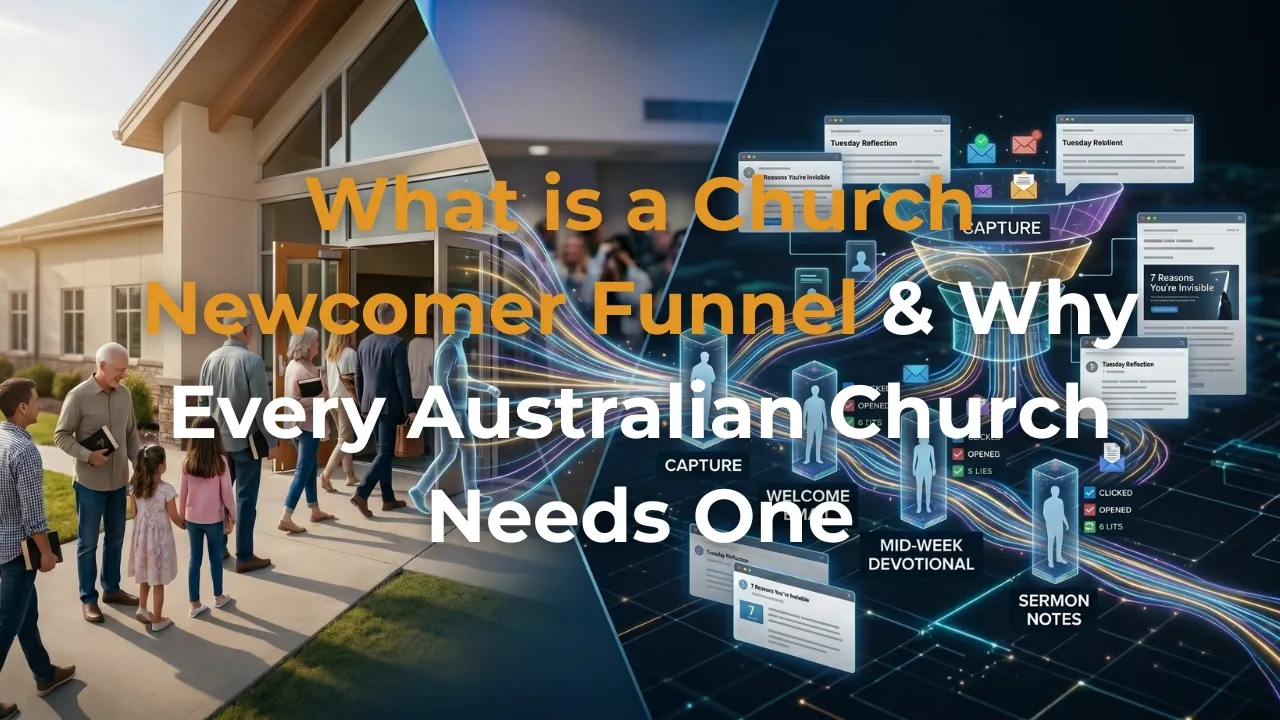
What Is a Church Newcomer Funnel and Why Every Australian Church Needs One
Jun 15, 2026Every Sunday, people visit Australian churches for the first time. Some of them come back. Many don't.
The ones who don't come back are not always uninterested. Sometimes they simply felt invisible. Nobody noticed them. Nobody followed up. The moment of openness they walked in with slowly closed — not because your church failed them on Sunday, but because nothing happened on Monday.
A newcomer funnel is the system that changes that. It's the digital pathway that takes someone from their first point of contact with your church — whether that's a Google ad, a social media post, or a visit on Sunday — and walks them, step by step, toward genuine community connection.
In this post I want to explain exactly what a newcomer funnel is, what it looks like in practice for an Australian church, and why having one is no longer optional for a church that takes its mission seriously.
What Is a Funnel?
A funnel is a marketing term for a sequence of steps that moves a person from initial awareness of your organisation to a specific desired outcome. The term comes from the shape — wide at the top where many people enter, narrow at the bottom where a smaller number reach the final outcome.
For a church, the funnel looks like this:
- Awareness — someone discovers your church exists (via Google, social media, a friend's recommendation)
- Interest — they want to find out more (visit your website, watch a sermon clip, check your social media)
- Connection — they make contact (fill in a form, register for an event, visit on Sunday)
- Community — they become part of your congregation (return regularly, join a small group, get baptised)
Most Australian churches have accidentally built something at the top of this funnel — a website, maybe some social media — but have nothing in the middle. People discover the church, become interested, make first contact, and then... nothing happens. The funnel has a hole in it.
A newcomer funnel plugs that hole.
The Four Components of a Church Newcomer Funnel
1. A Dedicated Landing Page
The entry point for most newcomer funnels is a dedicated landing page — a single, focused web page designed specifically for people who are new to your church. Not your homepage. Not your "About" page. A page that speaks directly to someone who doesn't know you yet, acknowledges their questions and concerns, and makes one clear invitation.
This page answers the questions a first-time visitor has before they've thought to ask them: What should I expect? Is there somewhere for my kids? What do people wear? When do services start? A well-designed newcomer landing page removes every barrier between curiosity and a first visit.
2. A Simple Contact Form
The form is where the funnel begins in earnest. It captures the newcomer's details — at minimum their name and email address — and triggers everything that happens next. The form should be short (no more than three or four fields), warm in its language, and easy to find on the page.
Forms can live on your newcomer landing page, on your homepage, at the bottom of a blog post, on an event registration page, or on a printed Sunday order of service with a QR code. Wherever someone might want to take a next step, there should be a way to do so.
3. An Automated Email Sequence
The moment someone fills in your form, an automated welcome email sequence begins. This is the heart of the newcomer funnel — the system that responds instantly, consistently and warmly to every person who expresses interest in your church, regardless of what time it is or who is available on your team.
A well-designed church welcome sequence typically includes five emails spread over two weeks — starting with an immediate welcome email within five minutes of the form submission, and ending with a gracious open invitation two weeks later. I've written about this in detail in my post How to Follow Up With Church Visitors Using Simple Email Automation.
4. A Staff or Volunteer Notification
The automated sequence handles the immediate response — but the goal is always a real human connection. When someone fills in your newcomer form, a notification should go to a designated staff member or volunteer so they can personally reach out after the automated sequence has done its initial work.
This notification can be a simple email alert, a text message, or a notification in your church management system. The important thing is that a real person knows a real person has expressed interest — and follows up personally at the right moment.
How it works
The Church Newcomer Funnel — From First Contact to Community
|
1
|
Someone discovers your church Via Google Ad, sermon clip on social media, a friend's recommendation, or a Sunday visit. This is the top of the funnel — awareness. |
|
2
|
They land on your newcomer landing page A focused, welcoming page that answers their questions and makes one clear invitation — to fill in the form and take a next step. |
|
3
|
They fill in the contact form Name, email, and an optional question. This is the conversion point — the moment of first contact that triggers everything else. |
|
4
|
Automated welcome sequence begins Within 5 minutes they receive a warm welcome email. Over the next two weeks they receive four more — a resource, an invitation, a check-in, and an open door. |
|
5
|
Your team receives a notification A staff member or volunteer is alerted so they can personally reach out at the right moment — after the automated sequence has done its warm-up work. |
|
✓
|
Real community connection happens The person visits in person, meets real people, joins a small group, and becomes part of your community. The funnel did its job — the church does the rest. |
What About People Who Find You on Sunday?
The newcomer funnel isn't only for people who find you online. It works just as well — and arguably better — for people who visit in person on a Sunday.
The simplest way to capture Sunday visitors into your digital funnel is a QR code on your Sunday order of service or a card at the seat that says "New here? We'd love to connect with you." The QR code links to your newcomer landing page — and once they fill in the form, the automated sequence takes over.
This means your Sunday hospitality team doesn't need to chase anyone down. The system handles the follow-up while your volunteers focus on warm, genuine human welcome in the room.
Is This Too Complicated for a Small Church?
I hear this concern often — and I want to address it honestly. A complete newcomer funnel sounds complex, but it doesn't have to be built all at once.
Here's a simple version that any church can set up in a single afternoon:
- A simple Google Form with name and email fields, linked from your website homepage
- A free MailerLite account with a single automated welcome email that fires immediately when someone submits the form
- An email notification to your pastor or a volunteer when a new submission arrives
That's not the complete system — but it's infinitely better than nothing. And it can be running today.
The more complete version — a dedicated landing page, a 5-email sequence, tagging, and staff notifications — takes more time and expertise to build. But even the simple version will make a meaningful difference to how your church responds to interested people.
Start somewhere
Simple Funnel vs Complete Funnel
| Simple Funnel Set up in an afternoon |
Complete Funnel DEO Ministry Harvest Package |
|
|---|---|---|
| Contact form | Google Form | Custom landing page with branded form |
| Email follow up | 1 welcome email | 5-email sequence over 2 weeks |
| Staff notification | Email notification | Tagged, segmented, timed notification |
| Thank you page | Generic Google confirmation | Branded thank you page with next steps |
| Google Ad Grant integration | Not connected | Fully integrated with conversion tracking |
The Connection to Your Google Ad Grant
If your church is using the Google Ad Grant — or planning to — a newcomer funnel is not optional. It is the thing that makes the grant work.
Your Google ads bring people to your website. Without a funnel, they arrive, look around, and leave. With a funnel, they land on a focused landing page, fill in a form, receive a warm welcome, and begin a two-week journey toward your community. The Ad Grant drives the traffic. The funnel converts it.
Google also requires that every Ad Grant account has at least one active conversion set up — and a form submission on your newcomer landing page is the most natural conversion for a church. The funnel and the grant are designed to work together.
Let Us Build Your Newcomer Funnel
At DEO Ministry, building a complete newcomer funnel — including the landing page, the contact form, the automated email sequence, the thank you page, the staff notification, and the Google Analytics conversion tracking — is included in our Harvest Package.
We write every email, design every page, set up every automation, and test the whole system before handing it over. You provide the pastoral heart. We build the system that delivers it.
If you'd like to find out what a newcomer funnel could look like for your specific church, book a free 30-minute strategy call. We'll look at your current setup and walk you through exactly what's possible.
Book Your Free Strategy Call →
Written by Daniel Jackson — The founder of DEO Ministry and a commissioned elder at Soma Blue Mountains. He holds a Master of Divinity from Christ College Sydney and a Master of Arts in Theology from SMBC. He has helped scale businesses to over $1,000,000 in annual turnover and is passionate about helping Australian churches use digital tools to reach more people with the gospel.