
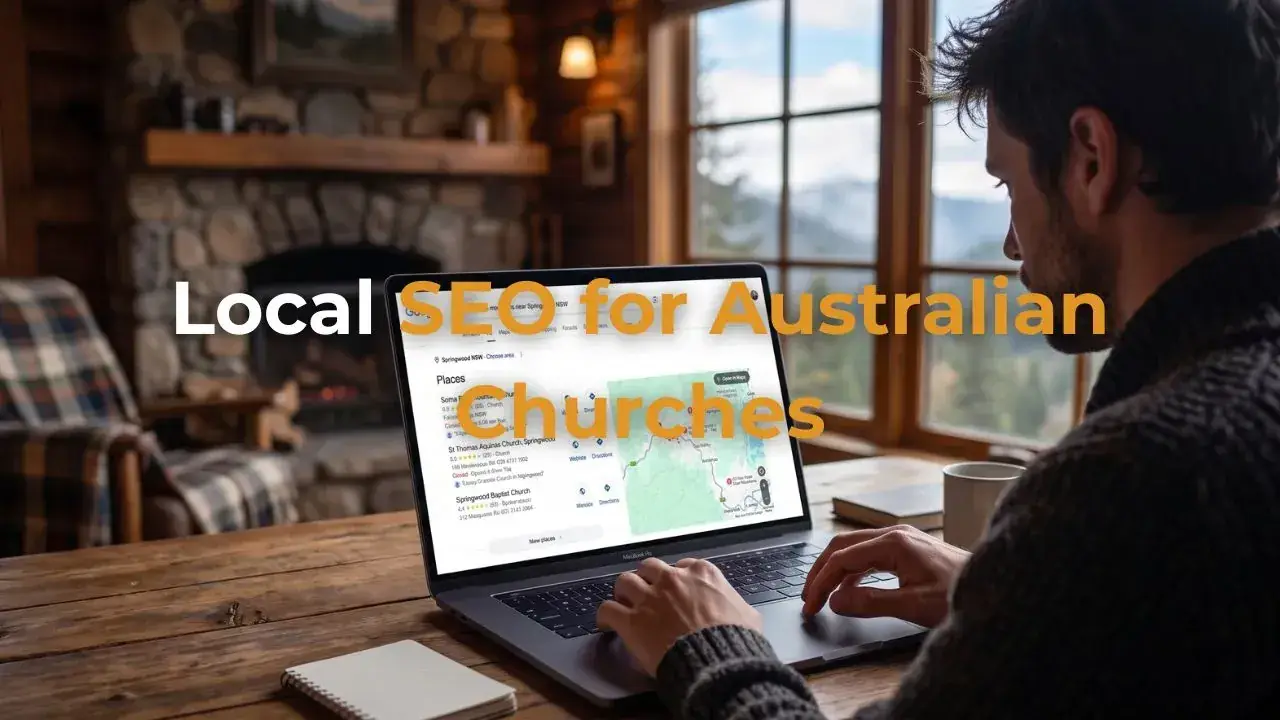
Local SEO for Australian Churches — How to Get Found in Your Suburb on Google
Jul 27, 2026There is a difference between being on Google and being found on Google — and for most Australian churches, that difference is enormous.
Your church probably already has a website. It probably shows up if someone searches for your church by name. But that's not the search that matters most for your mission. The search that matters is the one being made right now by someone in your suburb who doesn't know your name — who types "church near me" or "church [suburb]" or "Christian community [city]" and looks at what comes up.
Local SEO is the set of strategies that determines whether your church appears in those results. And most Australian churches have never deliberately applied any of them.
In this post I want to give you a practical, actionable guide to local SEO for churches — the specific things that will make your church more visible to people in your community who are searching for exactly what you offer.
What Is Local SEO and Why Is It Different?
SEO (Search Engine Optimisation) is the practice of making your website more visible in Google's search results. Local SEO is specifically about visibility in searches that have local intent — searches where the person is looking for something in a specific place.
"Church near me," "Baptist church Sydney," "community church Penrith," "church Blue Mountains" — these are all local searches. When someone makes one of these searches, Google shows them a mix of results including a map pack (the three businesses or organisations with pins on a map), organic website results, and paid ads (including Google Ad Grant results).
Local SEO primarily influences the map pack and the organic results. Getting these right is what determines whether someone in your community finds your church when they search.
The Five Local SEO Factors That Matter Most for Churches
1. Google Business Profile — The Most Important Factor
Your Google Business Profile (formerly Google My Business) is the single most important local SEO factor for a church. It's the listing that puts you on Google Maps and in the map pack for local searches. A complete, verified, regularly updated Google Business Profile significantly improves your local search visibility.
Key elements: verified address, accurate service times, complete description with local keywords, at least 10 photos, and genuine five-star reviews from your congregation. I've written a complete guide to setting up your Google Business Profile here: How to Set Up a Google Business Profile for Your Church.
2. Name, Address, Phone (NAP) Consistency
Google cross-references your church's name, address, and phone number across every place they appear on the internet — your website, your Google Business Profile, church directories, social media profiles, and any other online listings. If these details are inconsistent (different address formats, different phone numbers, different church name spellings), Google loses confidence in the accuracy of your information and ranks you lower.
Audit every place your church appears online and ensure the name, address, and phone number are exactly the same in every location.
3. Local Keywords on Your Website
For Google to know that your church serves people in a specific suburb or city, that suburb or city needs to appear naturally in your website content. Your homepage, About page, and contact page should all mention your suburb and local area — not as a keyword-stuffed list, but as natural language that tells visitors and Google where you are and who you serve.
"We're a community church based in Penrith, serving families across the Western Sydney region" — this is the kind of natural, location-specific language that helps Google connect your church with local searches.
4. Local Links and Mentions
Links from other local websites to your church's website — called backlinks — are one of the strongest signals Google uses to assess your authority and relevance in a local area. For churches, the easiest local backlinks to acquire are: a listing on your denomination's website with a link to your church, listings in local community directories, mentions in local news articles, and links from other local organisations you partner with (community groups, charities, schools).
5. Regular Fresh Content
Google favours websites that are regularly updated with fresh, relevant content. A church website that hasn't changed in six months sends a signal that the site is not actively maintained. Publishing a weekly sermon blog post, updating your events page regularly, and publishing new pages for sermon series all contribute to Google's perception of your site as active and relevant.
Your local SEO audit
Local SEO Checklist for Australian Churches
| ✓Google Business Profile — verified, complete, with photos and reviews |
| ✓NAP consistency — same name, address, and phone everywhere online |
| ✓Local keywords — suburb and city mentioned naturally on homepage, About, and Contact pages |
| ✓Denomination listing — church listed on your denomination's website with a link |
| ✓ACNC listing — church listed on the ACNC register with accurate website URL |
| ✓Regular content published — website updated at least weekly with new sermon or blog content |
| ✓Google Search Console — set up to monitor how Google sees and indexes your website |
Local SEO vs the Google Ad Grant — How They Work Together
Does the Google Ad Grant make local SEO unnecessary — if you're paying for the top position with ad credits, why does organic search ranking matter?
The answer is that they serve different functions and work best together.
The Google Ad Grant gives you immediate visibility at the top of search results for specific keywords you choose. But it only works for keywords you've actively targeted, it doesn't appear in the map pack, and it requires ongoing management to maintain the 5% click-through rate required to keep the grant active.
Local SEO gives you organic visibility — appearing in the map pack, ranking naturally for a broader range of local searches, and being discoverable even when your ad campaigns aren't targeting a specific keyword. Organic rankings are also more trusted by many users than paid results.
The churches with the strongest local digital presence use both: the Google Ad Grant for targeted, immediate visibility and local SEO for broad, sustainable organic discovery.
Better together
Local SEO vs Google Ad Grant — What Each Does
| Local SEO | Google Ad Grant | |
|---|---|---|
| Time to see results | 3-6 months | Within 1month after activation |
| Appears in map pack | Yes | No |
| Ongoing cost | Time investment only | Free (grant-funded) |
| Keyword targeting | Broad — Google decides | Precise — you choose |
| Requires maintenance | Ongoing content | Fortnightly management |
How Long Does Local SEO Take to Work?
Local SEO is not a quick fix — it's a long-term investment. Most churches who implement the strategies in this post will start to see improvement in their local search visibility within 60-90 days, with significant results typically visible at the 6-month mark.
The most impactful things you can do immediately — the Google Business Profile setup and NAP consistency — can produce noticeable results within 30 days. The longer-term strategies — content production, backlink building, and review accumulation — compound over months and years.
The good news is that local SEO improvements are cumulative and durable. Unlike paid advertising, which stops the moment you stop paying, SEO improvements continue to deliver results long after the initial work is done.
Let Us Handle Your Church's Local SEO
At DEO Ministry, local SEO optimisation is part of our Seed Package. We set up and optimise your Google Business Profile, audit your NAP consistency, update your website copy with local keywords, and build your local link profile as part of the ongoing service. Combined with your Google Ad Grant campaigns, this gives your church maximum visibility in local search — both in the map pack and in organic and paid results.
Book Your Free Strategy Call →
Written by Daniel Jackson — The founder of DEO Ministry and a commissioned elder at Soma Blue Mountains. He holds a Master of Divinity from Christ College Sydney and a Master of Arts in Theology from SMBC. He has helped scale businesses to over $1,000,000 in annual turnover and is passionate about helping Australian churches use digital tools to reach more people with the gospel.