
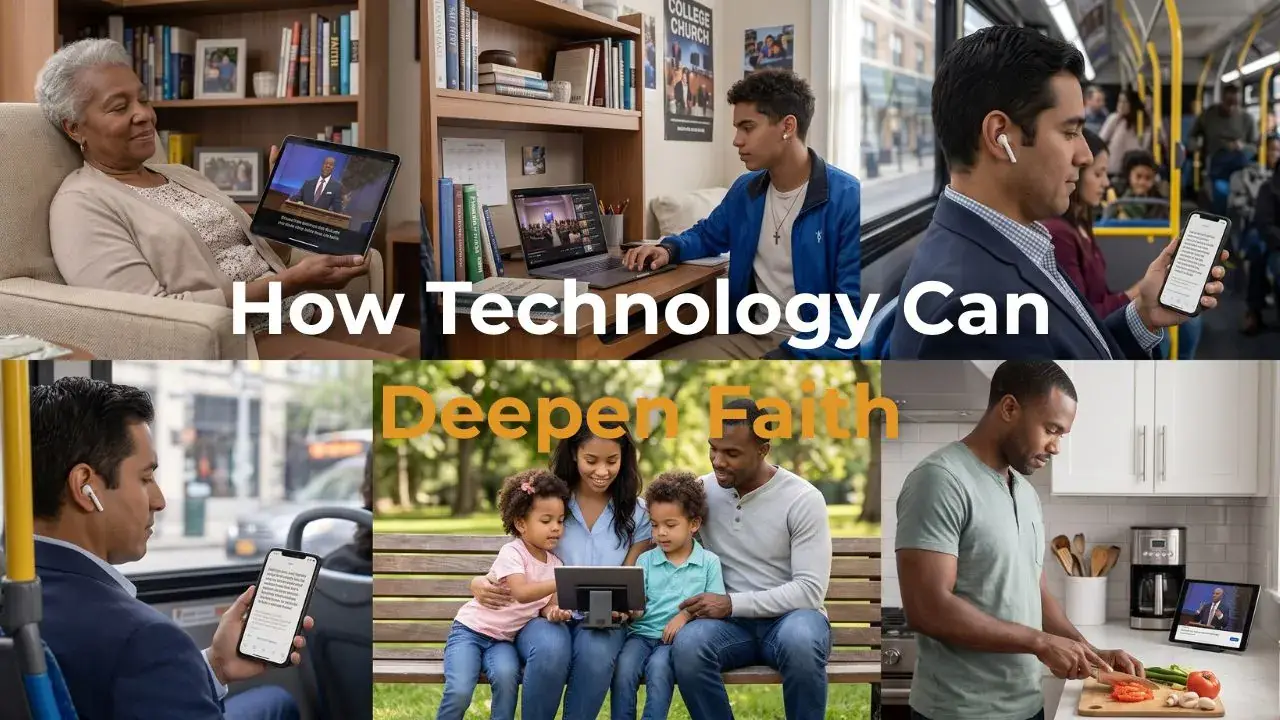
Digital Discipleship — How Technology Can Deepen Faith Beyond Sunday
Aug 31, 2026There is a tension at the heart of the church's relationship with digital technology — and I think it's worth naming honestly.
On one hand, we've been exploring how digital tools can help churches reach more people — using Google Ads, social media, and content systems to extend the church's visibility and connect with people who don't yet know it exists. That is outreach. And it's important.
But outreach is not the only thing the church is called to do. Discipleship — the ongoing formation of people into the image of Christ — is equally central to the church's mission. And the question of whether digital technology can serve discipleship, not just outreach, is one I think about deeply.
In this post I want to explore what digital discipleship looks like — how technology, used faithfully and wisely, can support the ongoing spiritual formation of your congregation between Sundays.
The Monday to Saturday Problem
For most Australian churchgoers, their primary point of contact with their church community is Sunday. They gather, they hear the Word, they connect with people they know, and then they go home. By Wednesday the sermon has faded. By Friday the emotional experience of gathered worship has been completely displaced by the demands of ordinary life.
This is not a failure of commitment — it's the reality of ordinary human experience. We are forgetful, distracted, and surrounded by voices competing for our attention. The idea that a single gathering per week is sufficient for robust spiritual formation is challenged by both theological reflection and practical observation.
The early church didn't have this problem — they met daily, shared meals, lived in proximity, and formed each other through constant mutual presence. Most contemporary Australian Christians don't have that option. But they do have something the early church didn't: constant digital connectivity.
The question is whether the church uses that connectivity wisely, or leaves it entirely to other voices to fill.
What Digital Discipleship Is — and Isn't
Let me be clear about what I mean by digital discipleship — and equally clear about what I don't mean.
Digital discipleship is not a replacement for embodied community. It cannot substitute for the gathered church, the breaking of bread, the laying on of hands, the pastoral conversation over coffee, or the mutual bearing of burdens that happens when people are physically present with each other. Any vision of digital discipleship that attempts to replace these things is theologically deficient.
What digital discipleship can do is bridge the gap between Sundays. It can keep the congregation connected to the teaching they heard, extend the conversation started in a sermon, provide resources for personal Bible study, and create touchpoints of community and encouragement that wouldn't otherwise exist.
Done well, digital discipleship makes the Sunday gathering more fruitful — because people arrive having engaged with the Word and with each other throughout the week, rather than arriving cold from five days of spiritual disconnection.
Five Practical Digital Discipleship Tools for Australian Churches
1. The Weekly Congregation Email
A well-written weekly email to your congregation is one of the highest-value digital discipleship tools available to a church. It connects Sunday's teaching to Monday's life, provides a passage for personal reflection, shares a prayer point, and keeps the community informed and engaged throughout the week. Sent on a Friday or Monday, it serves as a bookend to the Sunday gathering.
2. The Church Podcast
Your sermon, available as a podcast, gives congregation members a way to re-engage with the teaching during the week — on a commute, during exercise, or in a quiet moment. It also enables members to share specific messages with friends or family who are exploring faith. Many people's faith journeys begin with a podcast they stumbled upon during a Google or Spotify search.
3. Curated Social Media Content
Short form video clips from your pastor's sermons, posted three times per week on Instagram and TikTok, keep the congregation connected to the teaching throughout the week. They also serve the outreach function we've discussed elsewhere — but their discipleship value for existing members is significant. A 60-second clip on Thursday that revisits Sunday's key insight can do more for spiritual retention than any other mid-week touchpoint.
4. Digital Small Group Resources
Making small group discussion guides available on your website — tied to each sermon series — equips your small group leaders and encourages personal engagement with the teaching beyond the Sunday gathering. These can be simple PDF documents or dedicated pages on your website, and they serve both discipleship and SEO (people searching for "Bible study guides on anxiety" or "Christian discussion questions" can find your church's resources).
5. The Church Community Platform
Some churches are using private community platforms — whether a closed Facebook group, a WhatsApp community, or a dedicated church app — to create a space for congregation members to connect, share prayer requests, celebrate answers to prayer, and continue conversations started on Sunday. When managed well, these platforms can significantly increase the sense of community and belonging that keeps people engaged with the church.
Bridging the gap
Digital Touchpoints That Deepen Faith Between Sundays
| Day | Touchpoint | Discipleship purpose |
|---|---|---|
| Sunday | Sermon + gathered worship | The primary gathering — teaching, community, sacrament |
| Monday | Podcast + sermon clip #1 | Re-engage with Sunday's teaching on commute or exercise |
| Tuesday | Sermon clip #2 | Second angle on the same truth — reinforces learning |
| Wednesday | Blog post | Written reflection for those who process through reading |
| Thursday | Sermon clip #3 | Builds anticipation — often a question or challenge |
| Friday | Congregation email | Weekly summary, prayer points, community news, next step |
| Saturday | Anticipation content | Builds excitement for Sunday — "Join us tomorrow as we continue..." |
The Warning I Want to Give
I want to end this post with a genuine caution, because I think it's important and I don't want to be misunderstood.
Digital tools are means, not ends. The goal of digital discipleship is not to create more content or more engagement — it's to support people in their genuine pursuit of God and their genuine connection with the community of God's people. A church that produces excellent digital content but has shallow community, poor pastoral care, and weak embodied worship has got its priorities badly wrong — regardless of how many people watch its Instagram Reels.
The digital tools I've described in this post are designed to serve discipleship, not replace it. They work best when they exist within a church that already takes the gathered community seriously — that preaches the Word faithfully, loves its people well, and understands that no algorithm can substitute for the Holy Spirit at work in a gathered community of believers.
Technology is a tool. Handle it carefully, use it purposefully, and keep it in its proper place.
Keep the balance
Digital Discipleship vs Digital Replacement
| Digital discipleship (good) | Digital replacement (avoid) |
|---|---|
| Technology bridges the gap between Sundays | Technology substitutes for Sunday gathering |
| Podcast helps the congregation re-engage with the sermon | Online streaming replaces the physical gathering |
| Congregation email builds community and connection | Digital communication replaces pastoral care |
| Content quality serves and honours the gospel message | Production values become more important than substance |
How DEO Ministry Supports Church Discipleship Digitally
At DEO Ministry, everything we build — the content systems, the email sequences, the sermon clips, the blog posts — is designed with the discipleship of your congregation in mind, not just the acquisition of new visitors. We believe the best digital strategy for a church serves both outreach and formation, and we design our work with that dual purpose explicitly in view.
If you'd like to talk about how a well-designed digital system could serve both the outreach and discipleship mission of your church, book a free 30-minute strategy call.
Book Your Free Strategy Call →
Written by Daniel Jackson — The founder of DEO Ministry and a commissioned elder at Soma Blue Mountains. He holds a Master of Divinity from Christ College Sydney and a Master of Arts in Theology from SMBC. He has helped scale businesses to over $1,000,000 in annual turnover and is passionate about helping Australian churches use digital tools to reach more people with the gospel.